We study the functional relationships between gene expression, chromatin state, and nuclear organization, with a focus on identifying regulatory factors and elucidating the molecular mechanisms that govern heterochromatin formation, propagation, and inheritance.
Eukaryotic genomes are organized into distinct functional domains that are either transcriptionally active (euchromatin) or transcriptionally repressed (heterochromatin), a fundamental architecture that underpins genome stability and cellular identity. Once established, heterochromatin can spread along chromosomes and is stably maintained through mitotic and meiotic divisions, enabling epigenetic inheritance across generations. Despite its central role, the spatiotemporal regulation of heterochromatin dynamics remains poorly understood.
Our research addresses key unresolved questions, including what drives heterochromatin nucleation, which factors mediate its propagation, how spreading is constrained at domain boundaries, and how these processes are dynamically coordinated within the nuclear environment.
To address these challenges, we integrate complementary experimental strategies to systematically dissect heterochromatin regulation. We employ functional genome-wide screens to identify novel modulators of the heterochromatic state and use functional genomics to reconstruct the regulatory networks through which these factors interact. In parallel, we combine live-cell imaging, molecular biology, and biochemical approaches to resolve the mechanistic basis of heterochromatin regulation in vivo.
Together, these approaches enable a comprehensive and mechanistic understanding of heterochromatin regulation within the context of nuclear organization.
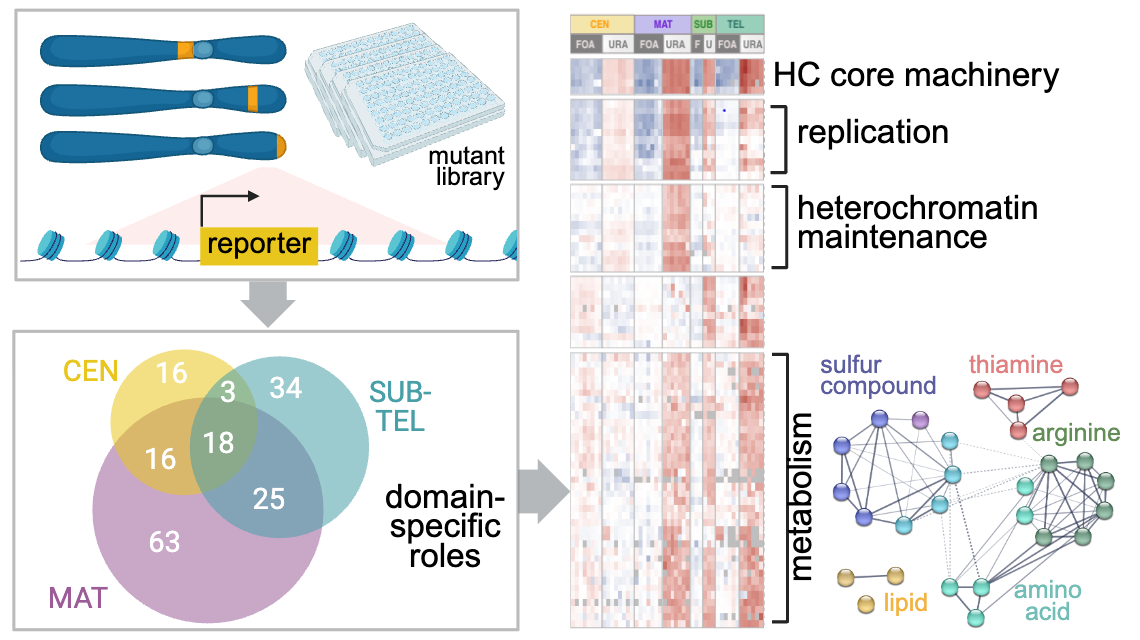
Heterochromatin is controlled by an intricate network of pathways whose contributions vary across the genome. Using systematic genetic screens, quantitative reporters and genetic interaction profiling, we identify novel silencing factors and determine how they cooperate in distinct chromatin contexts. Our goal is to move from identifying individual regulators toward reconstructing the functional networks that control silent chromatin.
Verrier et al. Open Biol 2015 ‧ Barrales et al. Genes Dev 2016 ‧ Flury et al. Mol Cell 2017 ‧ Muhammad, Sarkadi et al. NAR 2024 ‧ Seman et al. bioRxiv 2025
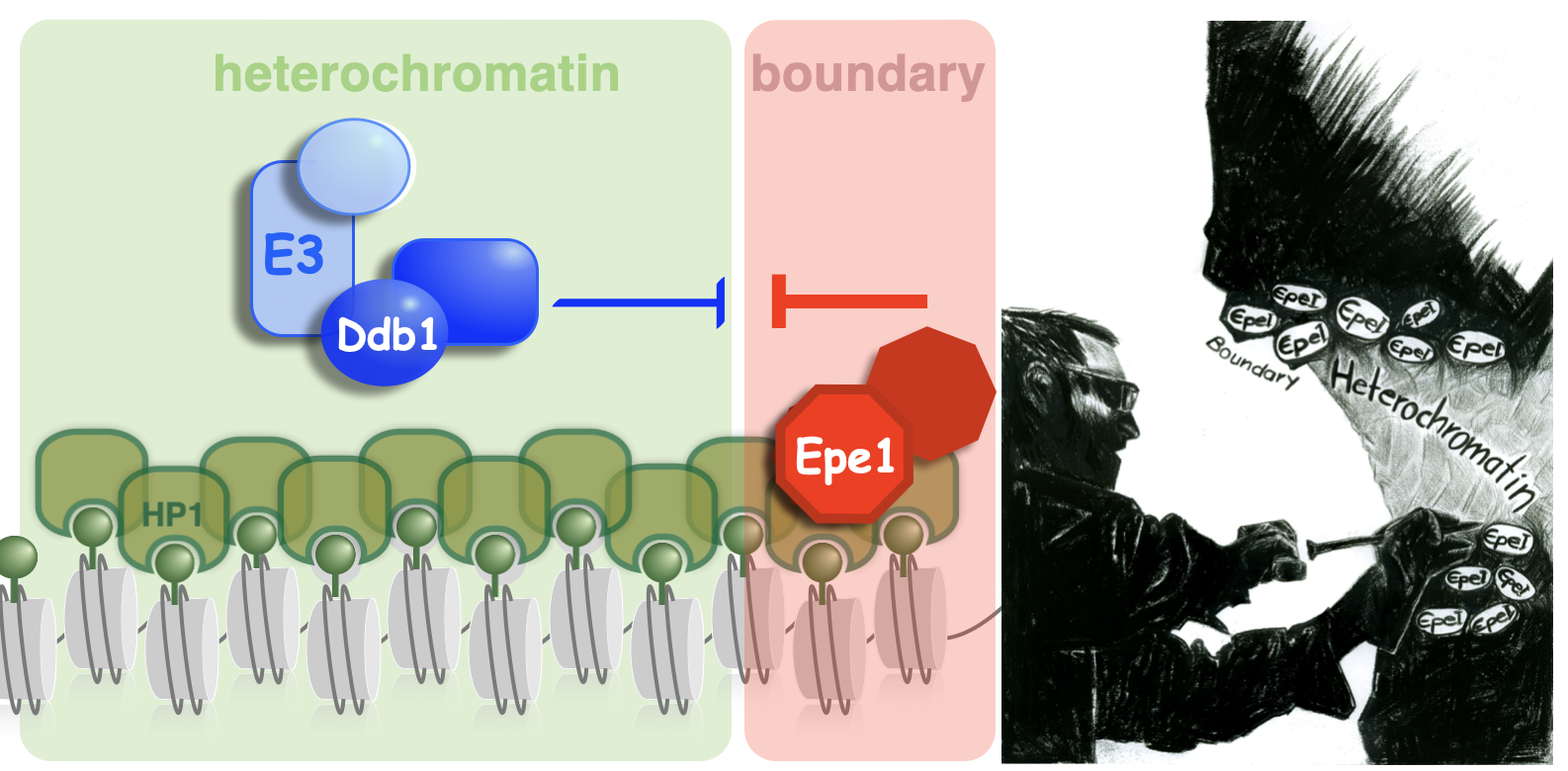
We uncovered mechanisms that define and protect chromatin domains, including ubiquitin-mediated removal of anti-silencing factors within heterochromatin (‘chromatin sculpting’) and sequestration-based safeguards that prevent inappropriate redistribution ('chromatin anchoring'). These findings reveal how opposing regulatory mechanisms preserve domain integrity and prevent aberrant spreading.
Braun et al. Cell 2011 ‧ Flury et al. Mol Cell 2017 ‧ Georgescu et al. Microbial Cell 2020
We identified the inner nuclear membrane protein Lem2 as a key regulator that coordinates gene expression at multiple levels, from heterochromatin and transposon silencing to RNA surveillance by the nuclear exosome. Together with our work on the dynamic tethering of repetitve DNA, these findings reveal the nuclear periphery as a regulatory hub integrating chromatin organization, RNA metabolism, and genome stability.
Barrales et al. Genes Dev 2016 ‧ Capella et al. Nature communications 2021 ‧ Martín Caballero et al. Nature SMB 2022

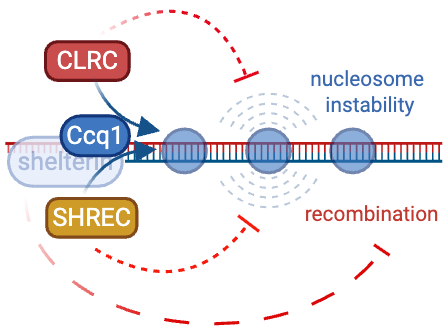
Subtelomeres are dynamic genomic regions where epigenetic regulation and genome stability intersect. We found that intrinsic nucleosome instability and recombination potential are counteracted by shelterin-dependent heterochromatin, while our recent work reveals distinct subtelomeric subdomains with different mechanisms and capacities for epigenetic inheritance. Together, these findings link local chromatin architecture to epigenetic diversity and genome plasticity.
van Emden, Forn, et al. EMBO Rep. 2019 ‧ Mazumder et al. bioRxiv 2025