
Partitioning the genome into active and silent chromatin requires mechanisms that define boundaries and maintain the identity of individual chromatin domains.
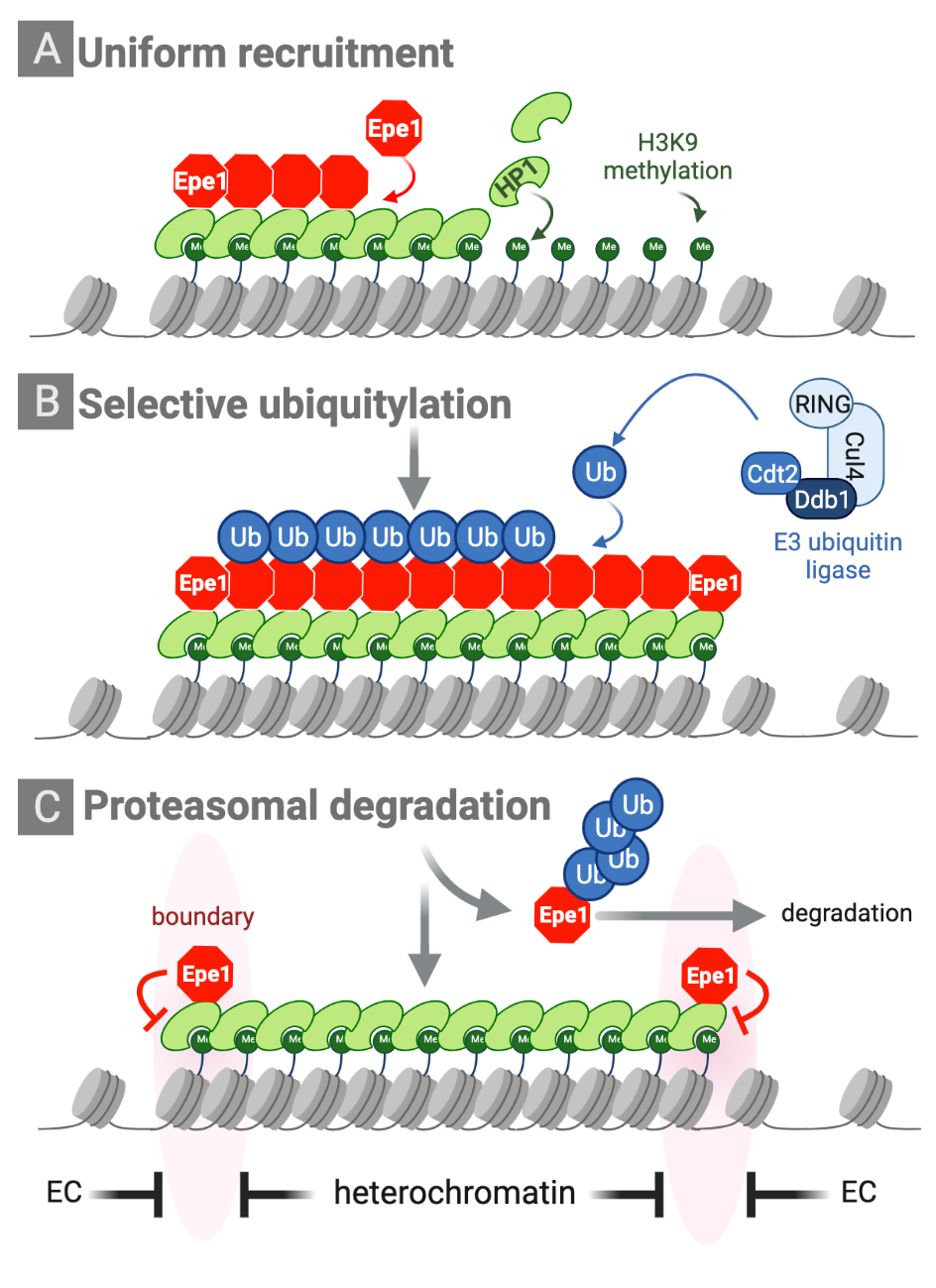 We discovered a mechanism by which the chromatin distribution of the anti-silencing factor Epe1 is shaped through ubiquitin-dependent degradation. Epe1 is recruited to heterochromatin through its interaction with HP1 proteins, but its uncontrolled accumulation disrupts heterochromatin. Epe1 is therefore selectively removed from the body of heterochromatin while being retained at domain boundaries, where it prevents heterochromatin from spreading into neighboring euchromatin.
These findings revealed that chromatin domains can be shaped through the selective removal of associated factors—a concept we termed chromatin sculpting (Braun et al., Cell, 2011). This extends the classical histone code concept by highlighting how the regulated distribution of chromatin-associated proteins contributes to the spatial organization and identity of chromatin domains.
A key question remained: what protects Epe1 from degradation at heterochromatin boundaries? Our ongoing work addresses this question and reveals an additional layer of boundary regulation.
 The integrity of chromatin domains can also be protected through anchoring to specific chromatin sites, thereby preventing promiscuous binding. In collaboration with Marc Bühler’s lab, we showed that sequestration of the acetyltransferase Mst2 to actively transcribed chromatin protects euchromatin from ectopic heterochromatin assembly. The same mechanism prevents Mst2 mistargeting to heterochromatin. This illustrates how opposing feedback loops maintain the integrity of chromatin domains (Flury et al. Mol Cell 2017; Georgescu et al., Microbial Cell 2020).