
The nuclear periphery is not merely a structural boundary but provides a spatial environment in which genome organization, gene regulation, and RNA metabolism can be coordinated. Our work has uncovered several mechanisms through which nuclear membrane-associated factors regulate chromatin, RNA surveillance and the stability of repetitive genomic regions.
We identified the conserved inner nuclear membrane protein Lem2 as a regulator of heterochromatin localization and silencing. Lem2 promotes the association of the SHREC repressor complex with heterochromatin while limiting accumulation of the anti-silencing factor Epe1, thereby connecting nuclear organization with the maintenance of repressive chromatin domains (Barrales et al., Genes Dev, 2016).
We subsequently discovered that Lem2 controls gene expression through a second, mechanistically distinct pathway. Lem2 interacts with the nuclear-exosome targeting machinery, including the MTREC component Red1, and promotes recruitment and degradation of meiotic and non-coding RNAs at the nuclear periphery. This function is independent of Lem2-mediated heterochromatin silencing and reveals that the nuclear envelope can coordinate both transcriptional and post-transcriptional repression within the same spatial compartment (Martín Caballero et al., Nat Struct Mol Biol, 2022).
Lem2-dependent repression extends beyond conventional heterochromatin. We found that Lem2 also contributes to the silencing of LTR retrotransposons, which are largely devoid of H3K9 methylation and are only weakly dependent on the SHREC pathway. Loss of Lem2 has also been linked to altered recombination between LTR elements, suggesting a role in maintaining the stability of repetitive sequences. Whether Lem2 controls LTRs by recruiting another, yet unidentified regulator factor or repressor complex remains an open question (Barrales et al., Genes Dev, 2016; Braun & Barrales, Nucleus, 2016).
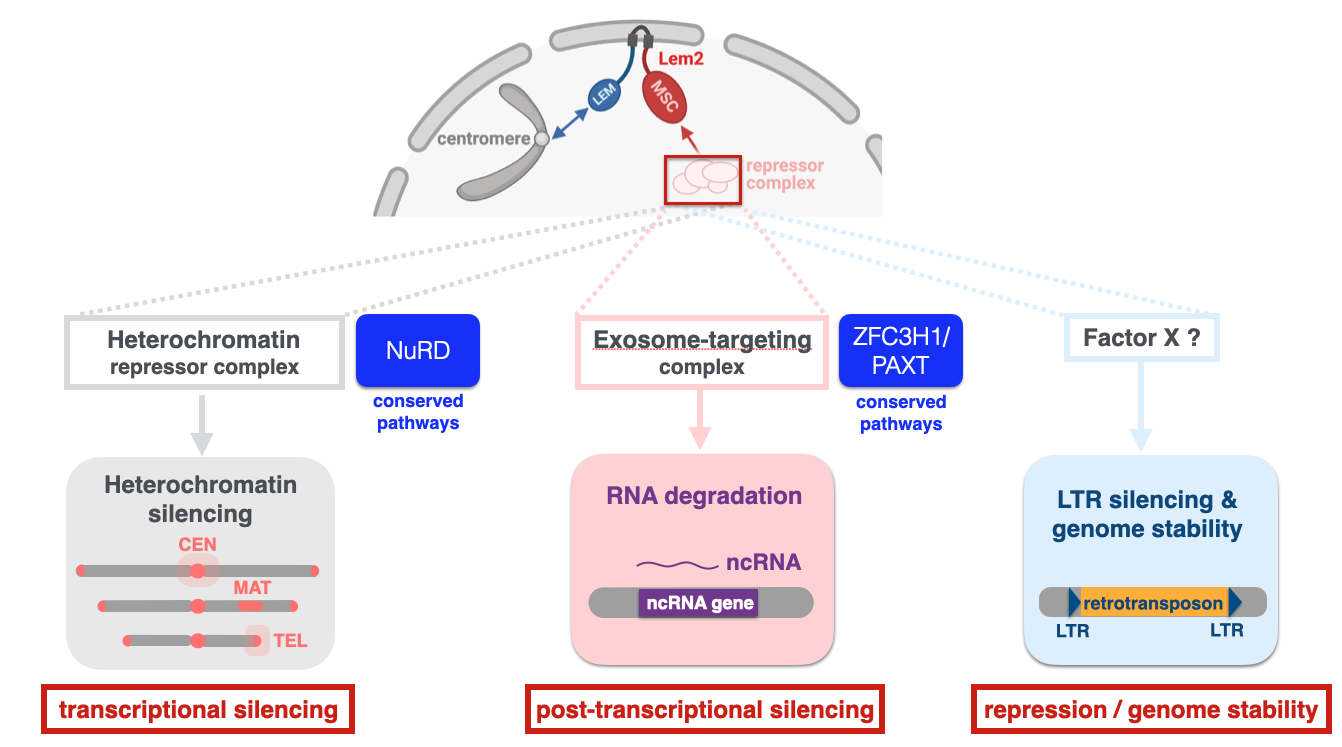
Together, these findings suggest that Lem2 acts as a regulatory platform at the nuclear membrane, coupling spatial genome organization to distinct transcriptional and post-transcriptional regulatory pathways.
Spatial confinement at the nuclear periphery can also protect repetitive sequences from inappropriate recombination. In budding yeast, rDNA repeats are tethered to the nuclear membrane through the CLIP–cohibin complex, thereby contributing to rDNA stability. Notably, CLIP contains Heh1, the budding yeast homolog of Lem2, together with its partner Nur1. Upon DNA damage, however, this attachment must become reversible: phosphorylation and SUMOylation of Nur1 recruit the Cdc48/p97 segregase, which promotes untethering of damaged rDNA from the nuclear membrane. The released repeats can then relocate from the nucleolus into the nucleoplasm, where they become accessible for homologous recombination and repair. This illustrates how regulated anchoring and release balance genome protection with access to DNA repair pathways (Capella et al., Nat Commun, 2021).
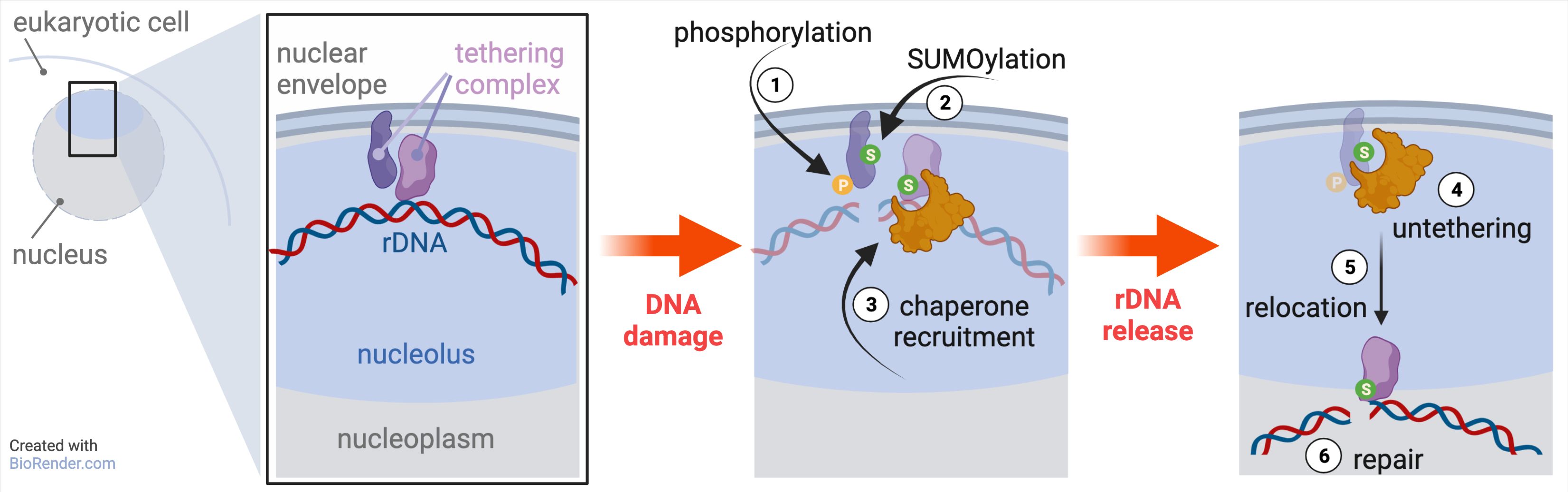
Together, these studies support a model in which the nuclear periphery acts as a dynamic regulatory platform, integrating chromatin-based silencing, RNA degradation and genome maintenance rather than serving as a passive site of genome attachment.