
Subtelomeres are repetitive chromosome regions that must balance two seemingly opposing properties: they require stable chromatin states to protect chromosome ends, yet their sequence organization and evolutionary dynamics make them intrinsically prone to variation. Our work investigates how DNA sequence, chromatin architecture and epigenetic regulation interact to balance genome stability with subtelomeric plasticity.
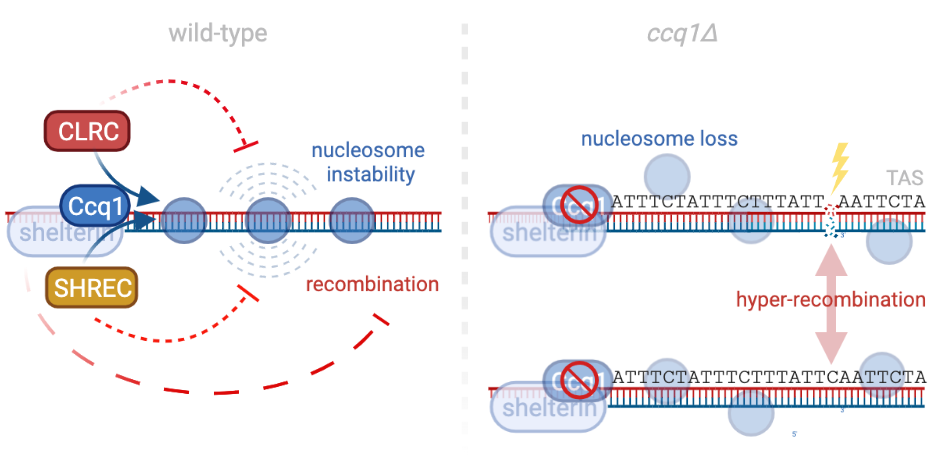
We discovered that telomere-associated sequences (TAS) in S. pombe possess unusual intrinsic properties. TAS are hyper-recombinogenic and contain metastable nucleosomes. The shelterin component Ccq1 counteracts this intrinsic chromatin instability by recruiting the heterochromatin machinery, including CLRC and SHREC, thereby stabilizing nucleosomes and coupling heterochromatic gene silencing to chromosome-end protection.
Remarkably, TAS-associated nucleosome instability is encoded by the underlying DNA sequence itself and can be transferred to an internal chromosomal location. In the absence of functional Ccq1-mediated telomere protection, these sequences can promote recombination between chromosome ends, revealing an inherent potential for telomere plasticity (van Emden, Forn et al., EMBO Rep, 2019).
Beyond this sequence-encoded chromatin instability, our recent work reveals another layer of subtelomeric complexity. Rather than behaving as one continuous and uniformly regulated heterochromatin domain, subtelomeric homology (SH) regions are organized into discrete subdomains with distinct mechanisms of heterochromatin establishment and maintenance. Telomere-proximal regions depend strongly on canonical shelterin and RNAi pathways, whereas more distal regions rely on additional chromatin regulators, including nucleosome remodelers, histone chaperones and boundary-associated factors.
Using single-cell reporters and multi-generational live imaging, we further found that these subdomains differ in their ability to maintain and re-establish silencing, giving rise to a spectrum of robust, metastable and fragile epigenetic states. Naturally occurring structural variants can shift these local states, demonstrating how changes in subtelomeric genome architecture can generate epigenetic diversity (Mazumder et al., bioRxiv, 2025/2026).
Together, these studies reveal subtelomeres as intrinsically dynamic chromosomal environments in which DNA sequence, genome architecture, and chromatin regulation determine both genome stability and epigenetic inheritance. We propose that the interplay between sequence-encoded instability, heterochromatin-mediated protection and position-specific epigenetic regulation allows chromosome ends to remain protected while retaining the capacity for structural and epigenetic variation.